
How to Automate B2B Collections
Learn how to automate B2B collections with AI agents and workflows. Reduce DSO by 20 days while preserving customer relationships. Step-by-step guide.
 Arthur Guerin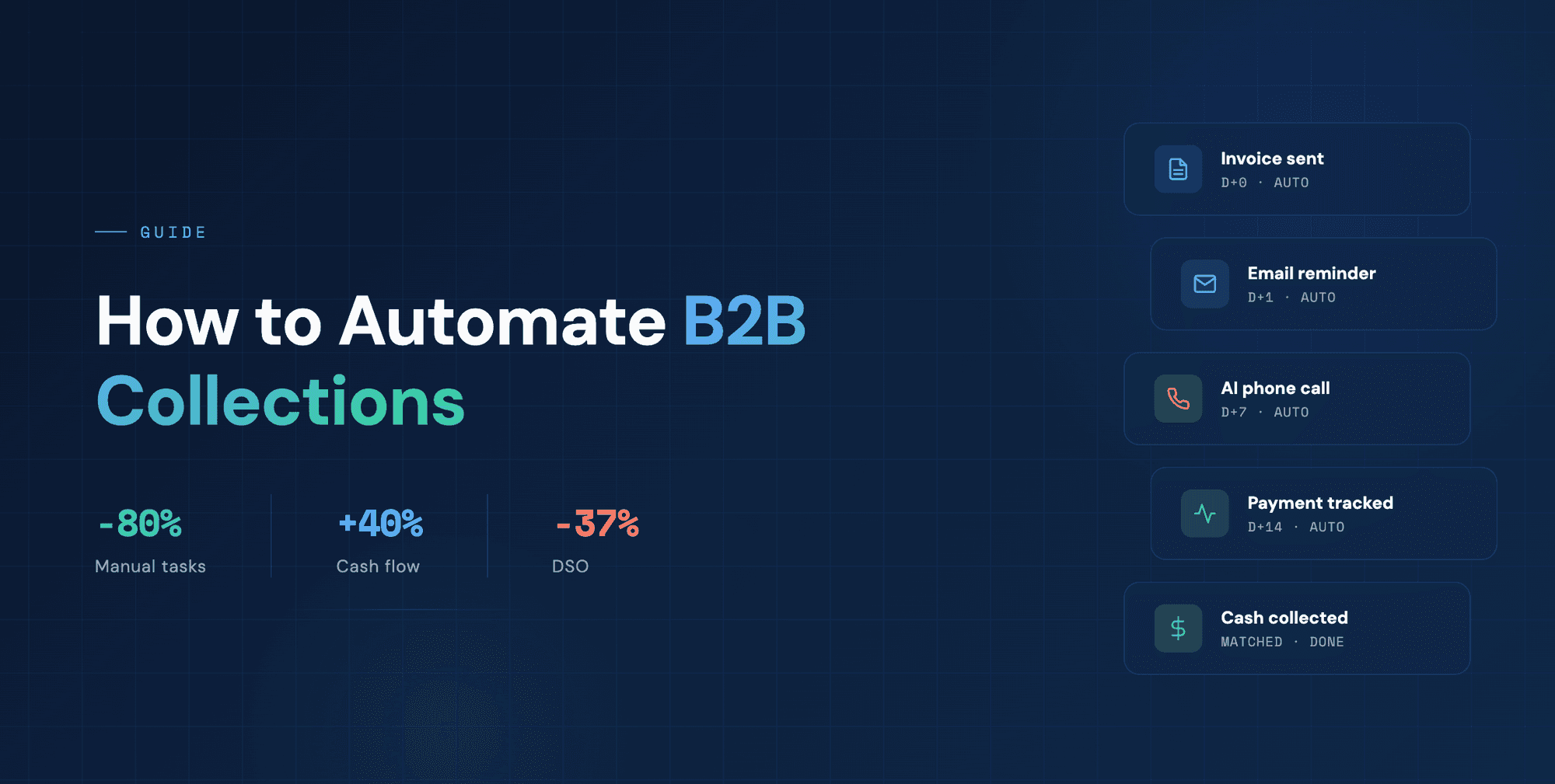
Late payments remain one of the most persistent challenges. Reports show that around 47% of B2B invoices in the EU are paid late, with average DSO reaching 52 days. More than half of European companies cite payment delays as a major operational concern. For finance teams, this means considerable hours spent chasing receivables instead of focusing on strategic priorities.
Automation offers a practical path forward. AI agents and automated workflows can handle routine collection tasks while preserving the human relationships essential to B2B commerce. Here's how to implement collections automation effectively.
Why Manual Collections Processes Fall Short
Manual collections processes create predictable problems. Your accounts receivable team sends reminder emails, makes phone calls, logs activities, and tracks payment promises across spreadsheets or disconnected systems. Each overdue invoice requires multiple touchpoints before payment arrives.
The business impact extends beyond operational inefficiency. European Commission data indicates that roughly one quarter of EU insolvencies are linked to late payments from customers. When cash is locked in receivables, companies face difficult choices about investment, hiring, and growth. SMEs feel this pressure most acutely, as they lack the cash reserves to absorb extended payment delays.
Automation addresses both capacity and consistency. Where a human team would send reminders sporadically based on workload, automated systems execute the collection process reliably. Where an overwhelmed collector might skip follow-ups during busy periods, automation maintains discipline across every account.
Companies implementing collection automation report DSO reductions of 30%. Efficiency gains come primarily from eliminating manual data entry, automating communications, and surfacing priority accounts for human attention.
Understanding AI Agents in Collections
AI agents represent an evolution beyond simple automation rules. Traditional automation follows static workflows: if an invoice is 30 days overdue, send reminder email A; if 45 days overdue, send reminder email B. AI agents make contextual decisions based on multiple factors.
An AI agent evaluates each customer's payment history, communication preferences, response patterns, and risk profile. It then determines the optimal channel, timing, and message tone for outreach. If a customer typically pays after a phone call but ignores emails, the AI agent prioritises phone contact. If another customer responds to late afternoon messages but not morning ones, the agent adjusts timing accordingly.
For most companies, the practical value of AI lies in consistent execution at scale. AI ensures every account receives appropriate attention based on defined criteria, something difficult to achieve with manual processes alone.
Four Steps to Automate Your B2B Collections
Step 1: Audit Your Current Collection Process
Before implementing automation, document your existing processes.
When do you send the first payment reminder? How many follow-ups occur before escalation? Which channels do you use for different customer types? Who handles each stage of collection? What triggers escalation to legal action or write-off?
This audit reveals bottlenecks and manual tasks suitable for automation. Pay particular attention to time spent on data gathering, status updates, and routine communications.
Be honest about current performance. Calculate your existing DSO, average collection cost per invoice, and percentage of invoices requiring escalation. These baseline metrics determine whether automation delivers meaningful improvement.
Step 2: Automate Routine Outreach
Routine outreach consumes the majority of collection effort while presenting the lowest complexity. These communications are ideal automation candidates:
Pre-due reminders: Messages sent 7 to 14 days before the due date, confirming invoice receipt and payment details.
First-stage reminders: Communications sent 1 to 3 days after the due date, typically a polite prompt.
Scheduled follow-ups: Sequential messages at predetermined intervals, increasing in urgency.
Payment confirmations: Automatic acknowledgments when payments arrive, closing the loop.
Dunning sequences: Escalating message series for accounts that remain unresponsive.
The goal is not to remove humans from collections but to focus human time on accounts requiring judgment, negotiation, or relationship management.
Step 3: Implement Intelligent Escalation
Automation works best when combined with clear escalation triggers. Configure your system to route accounts for human attention based on:
Payment promises not kept after a defined period. Customer responses indicating disputes or complaints. High-value accounts exceeding an age threshold. Unusual changes in previously reliable payment patterns. Communications suggesting financial difficulty.
AI agents can help identify these signals by analysing response content and comparing behaviour against historical patterns. However, the escalation rules themselves require human judgment to define and refine.
Build in regular reviews of escalated accounts. Which escalations were appropriate? Which could have been handled through automation? This feedback loop improves system accuracy over time.
Step 4: Connect Collections to Your Financial Ecosystem
Standalone automation delivers limited value. Maximum impact comes from integrating your collection system with existing tools:
ERP and accounting software: Real-time invoice and payment data eliminates manual reconciliation. Major platforms offer pre-built connectors for SAP, Oracle, Microsoft Dynamics, and common mid-market systems like Xero and Sage.
CRM platforms: Customer relationship context informs collection tone and timing.
Banking systems: Automatic payment matching reduces manual cash application.
Credit monitoring services: Early warning of customer financial stress enables proactive outreach.
Integration complexity varies significantly. Budget for integration work when evaluating total implementation costs, as custom development can double project timelines.
Measuring Automation Success
Track these metrics to evaluate your B2B collections automation:
Days Sales Outstanding (DSO): The primary efficiency metric. Calculated as (Accounts Receivable / Total Sales) x 365 days. With EU averages around 52 days, realistic automation targets are 10 to 15 day reductions in the first year.
Collection Effectiveness Index (CEI): Measures how much of available receivables you actually collect within the period. Industry benchmarks suggest CEI above 80% is healthy; top performers exceed 90%.
Cost per collection: Total collection costs divided by recovered amount. Automation should reduce this over time, though implementation costs offset early gains.
Staff time reallocation: Hours shifted from routine tasks to high-value activities like dispute resolution and relationship management.
Customer feedback: Monitor complaints related to collection communications. Rising complaints suggest automation needs adjustment.
Review metrics monthly during implementation, then quarterly once stable. Look for trends rather than reacting to single data points.
Getting Started
You don't need months of deployment to start collecting. Cleavr connects to your invoicing tool in days and autonomously handles the entire collection cycle, from D+1 after invoicing to cash-in: internal follow-ups, calls, identifying the right contacts, payment tracking, matching, credit notes, and disputes.
Results observed across our clients:
- -80% manual tasks
- +40% cash flow
- -37% DSO
Your billing and order management teams are freed from 80% of the operational workload and can focus on what matters: customer relationships, dispute resolution, and strategic decisions.